

***************
The Fed and "Plunge Protection Team": Are They Manipulating Stocks?
Rumors are, the U.S. government "is propping up the stock market."
October 29, 2010
By Elliott Wave International
Out of thousands of questions recently submitted to us at Elliott Wave International, the most frequent one received is: "Can the Fed manipulate the stock market?" Read our expert's answer on this and other misleading “investment wisdom.” Read more.
You will find many intriguing Q&As at EWI's Message Board. We offer it as a free way for our Club EWI members and subscribers to interact with EWI and the Socionomics Institute's experts. We strive to answer every Message Board reader, and publicly post the best Q&As.
By far, the most frequent question we've been asked recently is:
"What is your take on the persistent internet chatter that the Federal Reserve is holding up the stock market via QE2, POMO, etc.? How can stocks ever decline again if the Fed is in control?"
We have several active Message Board posts that touch on "market manipulation." But here is an eye-opening chart that will help shed more light on this issue.
EWI President Robert Prechter published this chart in his October 2008 Elliott Wave Theorist. Review this chart carefully. For too many investors, the crash of 2007-2009 is becoming a hazy memory. And almost no one in the mainstream financial media talks about the utter panic in the markets in September-October 2008, the worst part of the crash.
If you think back to that time, you may remember that the Federal Reserve and U.S. government took many aggressive steps to help stop the collapse. Every time they would announce a new intervention, the market would cheer. Result? Prechter's chart gives an unequivocal answer:

So: Is the Fed and the "Plunge Protection Team" engaged in market manipulation? You can browse EWI's Message Board for some answers, but one thing is clear: When stocks were crashing two years ago, few dared to suggest that the Fed was in the saddle. Bob Prechter puts it best:
"When markets go up, the Fed seems to be in control; when they go down, it seems out of control. But the control aspect is an illusion."
Get the 33-page Market Myths Exposed eBook for FREE
Learn why you should think independently rather than relying on misleading investment commentary and advice that passes as common wisdom. Just like the myth that government intervention can stop a stock market crash, Market Myths Exposed uncovers other important myths about diversifying your portfolio, the safety of your bank deposits, earnings reports, inflation and deflation, and more! Protect your financial future and change the way you view your investments forever! Learn more, and get your free eBook here.
ITS SIMPLE.
To make things easier, I will summarize it.
What is Forex?
Forex stands for Foreign Exchange Market. Where you buy 1 currency over the other (exchange). Its a business, no matter what people say. It involve buying and selling like any other business only difference is the medium is currency.
How to trade Forex?
The idea behind forex trading is to make profit from the difference in prices. Simply put, buy when the price is low and sell it when the price is high. Its just like the item you buy in stores, the store keeper is selling it at a higher price to make profit except in Forex you can sell first at high price and buy back later when the price is low.
When to buy and when to sell?
Logically you will sell when the price is going down and you will buy when the price is going up. It is simple but in practice this is what killing most traders. Something so simple can be so complicated.
How to know when the price is going down/up?
The price is going down when it no longer making new high. The price is going up when it no longer making new low.
Final advice
Forex is a human activity. It involve buying and selling. Because it is a human activity, it is not predictable. You cannot predict when is the time you need to go to toilet or when you are going to cut your hair. It is all based on situation. Prediction is an over statement of intelligence in Forex. You dont need it.
Fortunately not everything is unpredictable. By nature human tends to follow what other people are doing. In Forex there is something called the Trend. It happen when lots of people are doing the same thing at the same time (follow??). when more and more people are buying, you buy. When more and more people are selling you sell.
Dont get greedy. Put a reasonable target for each trade and get out once you get your target. There will always be another trade tomorrow and you dont have to trade everyday to make profit. Btw, last week I only trade once.
Good luck to all you traders. For the new blood, take your time. Give it 2 years before you can understand it and go for the kill.
October Curse vs. Objective Analysis: The Choice Is Yours
October 12, 2010
By Elliott Wave International
Over the weekend, I went shopping for Halloween decorations. In the store, one of the clerks was wearing a white T-shirt with a puff-paint rendering of the Dow Jones Industrial Average. The line representing prices was the color of blood red, dripping and splashed across the front. When I asked him what it was, he said "the October Curse."
'Tis the season of stock market adages; those age-old Wall Street platitudes that claim stock prices perform a certain way during certain months of the year. The problem is, such correlations are hardly a guarantee.
Take October, for example. Yes, this month has marked some of the darkest periods in stock market history: 1929, 1987 and on. Historically, however, it's not the worst performing month. For example, the supposed "Halloween Jinx" failed to bring a deathly pallor to stocks in 2008, as the final days of that year's October saw the biggest weekly gain since 1974.
Remove Dangerous Mainstream Assumptions from Your Investment Process. Elliott Wave International's FREE 118-page Independent Investor eBook shows you exactly what moves markets and what doesn't. It will change the way you invest forever. Click here to learn more and download your free, 118-page ebook.
===================================================================
"As Goes The First Week of January, So Goes The Month"-- In the first week of January 2010, the stock market enjoyed a powerful winning streak. Yet, by the end of the month, prices were back in the red, circling the drain of a two-month low.
"Sell In May And Go Away" -- And don't come back 'till St. Leger's Day (September). If investors heeded this wisdom this year, they would have missed one of the strongest uptrends in stocks of the entire year from July to September.
"September Curse" -- If you think October is supposed to be bad, September is widely assumed to take the financial killing cake. Yet this year, U.S. stocks enjoyed their strongest September in 71 years!
Bottom line: Don't "buy" your trading strategy before the trend actually arrives. The choice comes down to old adages, or objective analysis. Pick the latter.
Remove Dangerous Mainstream Assumptions from Your Investment Process. Elliott Wave International's FREE 118-page Independent Investor eBook shows you exactly what moves markets and what doesn't. It will change the way you invest forever. Click here to learn more and download your free, 118-page ebook.
Video (Part 3): Prechter - Investing in Extreme Markets
Video (Part 3): Prechter - Investing in Extreme Markets
(Note: This interview was originally recorded on September 20, 2010)
In the video below, Robert Prechter talks to Yahoo! Finance Tech Ticker host Aaron Task and Henry Blodget about a technical pattern he sees forming in the Dow.
Get Up to Speed on Robert Prechter's Latest Perspective — Download this Special FREE Report Now.
Video (Part 2): Prechter: Ominous Pattern in the DJIA
Video (Part 2): Prechter: Ominous Pattern in the DJIA
(Note: This interview was originally recorded on September 20, 2010)
In the video below, Robert Prechter talks to Yahoo! Finance Tech Ticker host Aaron Task and Henry Blodget about a technical pattern he sees forming in the Dow.
Get Up to Speed on Robert Prechter's Latest Perspective — Download this Special FREE Report Now.
A Trader Walks Into A Bar... Pattern: HOP-portunity On Tap
September 29, 2010
By Elliott Wave International
There's a little known joke among the trading community that goes like this: "A trader walks into a bar... pattern: 'Ouch!' "
Fact is, if you don't know what you're doing, price bar analysis can be a bit "painful." Finding a discernable pattern in their grouping can feel like finding a hair in a hay stack.
But if you have the right teacher -- say someone who has used bar pattern analysis for twenty-plus years to signal dramatic moves in some the world's most watched markets -- well, then the discipline is invaluable. And right now, EWI is offering just that, free: the 15-page eCourse Book titled;
"How To Use Bar Patterns To Spot Trade Set-ups" by EWI's chief commodity analyst and Futures Junctures Service editor Jeffrey Kennedy.
In this free 15-page resource, Jeffrey Kennedy shows you the top 6 bar patterns from his personal repertoire. He provides each pattern with a definition, illustrations of its form, lessons on its application and how to incorporate it into Elliott wave analysis, and historical examples of its occurrence in major commodity markets.

For a real-life example, see the September 27 Daily Futures Junctures, where Jeffrey presents this daily chart of December Coffee that clearly identifies a "Popgun" at the May 2010 low.
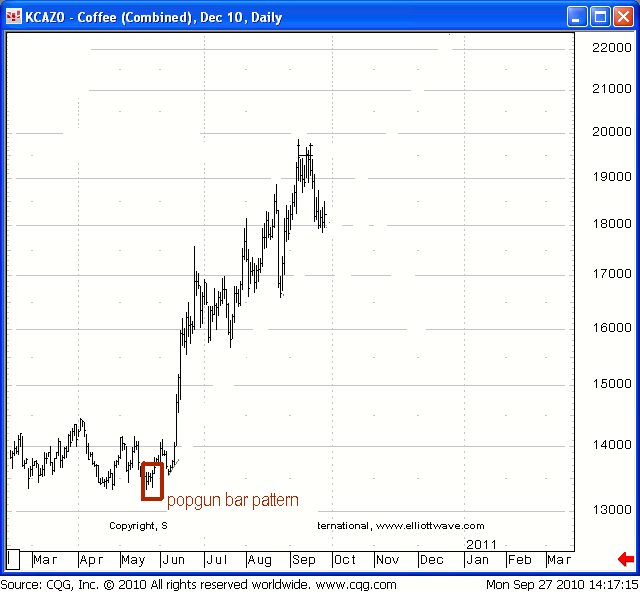
In this comprehensive collection, Jeffrey provides each pattern with a definition, illustrations of its form, lessons on its application and how to incorporate it into Elliott wave analysis, historical examples of its occurrence in major commodity markets, and ultimately -- compelling proof of how it identified swift and sizable moves.
Best of all is, you can read the entire, 15-page report today at absolutely no cost. You read that right. The "How To Use Bar Patterns To Spot Trade Setups" is available with any free, Club EWI membership.
This article was syndicated by Elliott Wave International and was originally published under the headline A Trader Walks Into A Bar... Pattern: HOP-portunity On Tap. EWI is the world's largest market forecasting firm. Its staff of full-time analysts led by Chartered Market Technician Robert Prechter provides 24-hour-a-day market analysis to institutional and private investors around the world.
Happy Trading!!
Deflation: The Trend That's Become Too Obvious To Ignore
September 23, 2010
By Elliott Wave International
As the biggest credit bubble in history continues to shrink, consumer prices have stayed flat over the past several months, meaning there is no sign of inflation to come, despite growing commitments from the U.S. government.
So what's keeping inflation at bay, given all the stimulus money promised?
The answer: Deflation -- an overwhelming urge for consumers to liquidate their assets for cash. And this new economic phase is finally becoming too obvious to ignore, as explained in recent commentary from the world's largest technical analysis firm.
"The economy is moving into a critical new phase, an outright deflation in which 'prices fall because people expect falling prices.'
Obviously, this implies an element of recognition, as efforts to protect against indebtedness and falling prices contribute to further declines. We can tell deflation is entering a new stage because of the language and ideas that financial observers now use to describe it."
-- The Elliott Wave Financial Forecast (September 2010)
***************
Get an independent look at the future of the U.S. economy by reading Robert Prechter's FREE Deflation Survival Guide now. Newly updated for 2010, Prechter's 90-page ebook on deflation reveals the biggest threat to your money right now. You'll learn not only how to prepare for deflation and adapt during it; you'll also learn how to survive it and -- most important -- prosper during it, so you'll be ready for the buying opportunity of a lifetime at its end. Click Here to Download Your Free 90-Page Deflation eBook Now.
***************
Here are a few recent comments about the new economic reality:
- "[New Jersey Governor] Christie spelled out the details of his proposal Tuesday. They include: repealing an increase in benefits approved years ago; eliminating automatic cost-of-living adjustments; raising the retirement age to 65 from 60 in many cases; reducing pension payouts for many future retirees; and requiring some employees to contribute more to their pensions." -- Associated Press (Sept. 15)
- "U.S. Home Prices Face Three-Year Drop as Inventory Surge Looms" -- Bloomberg (Sept. 15)
- "Atlanta Awash in Empty Offices Struggles to Recover From Building Binge" -- Bloomberg (Sept. 14)
- "The world economy faces a long, hard slog toward recovery and could slide into deflation and financial instability if leaders fail to deliver on promises of reform." -- Reuters (Sept. 10)
- "Deflation seems to have the upper hand lately in the debate among investors about inflation versus deflation." -- Marketwatch (Sept. 8)
- "With the release of the August sales figures, one thing is clear for car shoppers -- it's a buyer's market." -- Edmunds (Sept. 2)
- "20 Funds to Guard Against Deflation" -- Smartmoney (Aug. 29)
- "Dividend-Yield Signal Screams Deflation" -- Forbes (Aug. 25)
The word "deflation" also started appearing more in the financial media around 2002, but Robert Prechter, president of technical analysis firm Elliott Wave International and author of the 2002 New York Times best-seller Conquer the Crash, added in the updated 2009 edition of his book that the deflation references back then were in an entirely different context:
"The rarely used word deflation has become fashionable in financial discussion. ... It is fashionable, however, not to predict its occurrence but primarily to dismiss the idea that it has any serious likelihood of occurring.
The president of the Federal Reserve Bank of Dallas said in May [2004] that there is 'maybe one chance out of four' that deflation will occur."
-- Conquer the Crash, 2nd edition (2009)
And Prechter says the opinion from the Federal Reserve Bank of Dallas was not an isolated outlook at the time. Here's another quote from around the same time:
"Not one economist [of 67 surveyed] said it was 'very likely' the economy would slip into deflation, and only 6% said it was 'somewhat likely.' About 95% said deflation was 'not very likely' to happen."
-- Barron's (2003)
In hindsight, we know that economists -- in the aggregate -- were dead wrong about their deflation predictions.
As we saw above, references to "deflation" are increasing now -- because it's obvious.
So if economists were unable -- or worse, unwilling -- to warn you in advance about the threat of deflation a few years ago, what are they not warning you about now?
***************
Get an independent look at the future of the U.S. economy by reading Robert Prechter's FREE Deflation Survival Guide now. Newly updated for 2010, Prechter's 90-page ebook on deflation reveals the biggest threat to your money right now. You'll learn not only how to prepare for deflation and adapt during it; you'll also learn how to survive it and -- most important -- prosper during it, so you'll be ready for the buying opportunity of a lifetime at its end. Click Here to Download Your Free 90-Page Deflation eBook Now.
***************
This article was syndicated by Elliott Wave International and was originally published under the headline The "Outright Deflation" Economy Enters A "Critical New Phase".
EWI is the world's largest market forecasting firm. Its staff of full-time analysts led by Chartered Market Technician Robert Prechter provides 24-hour-a-day market analysis to institutional and private investors around the world.


